Guides
Accounting Software for Small Businesses in the UAE: A 2026 Buyer's Guide
Kyndle One Team · 12 September 2026 · 11 min read
VAT, Corporate Tax and the coming e-invoicing rules have quietly turned the shoebox of receipts into a liability. Here's how to choose accounting software for a small business in the UAE that keeps your books — and your compliance — running almost by themselves.
For years, plenty of small businesses in the UAE ran their books the same way: a drawer full of receipts, a WhatsApp thread with the accountant, and a spreadsheet that only one person understood. It worked, more or less, because nobody was really checking. That era is over. Between 5% VAT, the arrival of Corporate Tax, and mandatory e-invoicing on the way, the UAE now expects businesses to keep proper, structured financial records — and the shoebox simply doesn't cut it any more.
The good news is that the right accounting software turns compliance from a monthly panic into something that mostly takes care of itself. The hard part is choosing well, because most guides are written for other markets and skip the things that actually matter here. This is an in-depth look at how to choose accounting software for a small business in the UAE in 2026 — what the software should do, the local rules that shape the decision, and the honest trade-offs between your options.
What accounting software actually does now
"Accounting software" sounds like something only your accountant touches. In reality, a good system is a tool you use to understand and run the business. Beyond recording transactions, it should:
- Keep proper double-entry books automatically, so every sale, expense and payment lands in the right place.
- Produce your VAT return figures without a manual reconciliation.
- Track profit — the number Corporate Tax is based on — in real time.
- Show you who owes you money and what you owe others.
- Give you a profit & loss statement, balance sheet and cash-flow view on demand.
Judge any system on that whole job. A tool that only stores receipts is a filing cabinet; a tool that tells you whether the business is actually making money is an asset.
Bookkeeping tells you what happened. Good accounting software tells you what it means — and what to do next.
Why the UAE raised the stakes
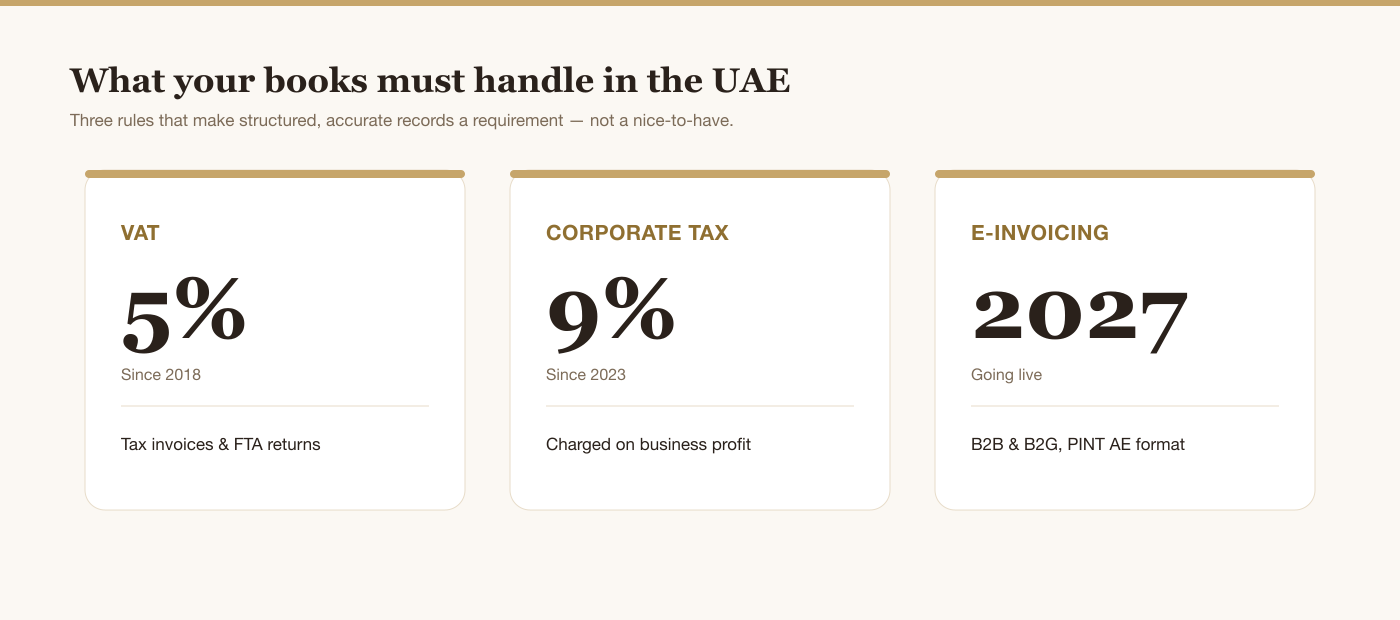
Three changes in a few short years have turned accounting from optional housekeeping into a genuine requirement. Understanding them makes the software decision much clearer.
VAT (since 2018)
5% VAT means you must charge tax correctly, issue compliant tax invoices, and file accurate returns with the Federal Tax Authority. Getting this wrong carries penalties. Your accounting needs to produce VAT-ready numbers as a matter of course, not as a scramble before each filing.
Corporate Tax (since 2023)
The UAE introduced Corporate Tax on business profits — 9% on taxable income above AED 375,000, for financial years starting on or after 1 June 2023, with relief available for smaller businesses. Whatever your position, the practical effect is the same: you now need clean, defensible records of your profit, not just your sales. That's very hard to do from a spreadsheet and easy to do from software that keeps proper books.
E-invoicing (from 2027)
Mandatory e-invoicing for B2B and B2G transactions is being rolled out over the Peppol network using the PINT AE format, going live for larger businesses from 1 January 2027 and others from 1 July 2027. Your accounting and invoicing will need to speak this structured format, so choosing a system that's already preparing for it saves you a migration later.
Together, these three make a simple point: the UAE now expects structured, accurate, year-round records. Software is by far the easiest way to keep them.
What to look for in the UAE
Here are the criteria that separate accounting software you'll be glad you chose from software you'll outgrow or fight. The first three are local and are exactly where global tools tend to fall short.
1. Real UAE VAT handling
The software should apply 5% VAT correctly, distinguish standard, zero-rated and exempt items, produce proper tax invoices and simplified tax invoices, and generate the figures you need for your FTA return. If VAT is a manual calculation you bolt on afterwards, keep looking.
2. Corporate Tax readiness
Because tax is now charged on profit, your books need to track cost and profit accurately, all year. Look for software that captures the cost of what you sell, categorises expenses cleanly, and can show a proper profit & loss statement at any moment — so that when it's time to assess Corporate Tax, the number is already there and defensible.
3. E-invoicing readiness
If you invoice other businesses or government, ask any vendor what their e-invoicing plan is for the 2027 mandate. Software that is already capturing the right customer and tax data — and preparing to produce PINT AE invoices — will make that transition a non-event instead of a crisis.
4. Proper double-entry books, kept automatically
Some cheap tools are really just a cashbook — money in, money out. That's not accounting; it won't give you a balance sheet or stand up to scrutiny. You want genuine double-entry bookkeeping happening automatically in the background, so the books are always complete without you thinking about debits and credits.
5. It connects to your sales and expenses
The biggest source of accounting pain is re-entering the same data twice. If the point-of-sale system that rings up your daily sales and your books are separate, someone has to bridge them by hand — and that's where errors and lost hours live. The best setup is one where a sale, a payment or an expense is recorded once and flows straight into the books. No re-keying, no month-end reconciliation marathon.
6. Bank reconciliation and expense tracking
Matching your books to your bank statement is how you know the numbers are real. Good software makes reconciliation quick, and lets you log and categorise expenses (with receipts) as they happen, so nothing is forgotten and your profit figure is accurate.
7. The reports that actually help you
At a minimum you want a profit & loss statement, a balance sheet, and a cash-flow view, plus receivables and payables. These aren't just for the FTA — they're among the seven numbers every shop owner should track to stay profitable, showing whether the business is healthy, where the money goes, and who hasn't paid you yet. A P&L tells you if you made money last month; a balance sheet tells you what the business is actually worth; a cash-flow view warns you before the account runs dry. Software that surfaces these clearly, without you building them by hand, is doing its most valuable work.
8. Arabic and English, AED, multi-branch
Software built for the region should work in English and Arabic, keep your books in AED, and handle stock and accounts across multiple store locations if you have them — rolling everything into one clear picture rather than forcing you to bolt separate books together.
9. Built for an owner, not just an accountant
Traditional accounting software assumes a trained bookkeeper is driving. As a busy owner, you want something you can understand at a glance — plain-language screens, clear dashboards, and answers without a course in accounting. The best modern tools are powerful underneath but calm on the surface.
10. FTA-compliant record keeping and fair pricing
The FTA requires businesses to retain financial records for several years, so your software should store everything securely and let you retrieve it easily. And as with any subscription, compare the all-in cost for the features and users you actually need — watch for essentials like extra users or reports being locked behind higher tiers.
Your options, honestly compared
UAE small businesses generally choose between four approaches. Each has a place; the right one depends on your size and how much you want to handle yourself.
| Spreadsheet / manual | Global accounting app | All-in-one platform | |
|---|---|---|---|
| VAT & tax invoices | Manual, error-prone | Varies; not always localized | Built in for the UAE |
| Profit / Corporate Tax view | Hard to keep accurate | Good, if set up well | Live, from your real sales |
| Connects to sales & stock | No — re-keyed by hand | Sometimes, via integrations | Yes — one source of data |
| E-invoicing readiness | None | Depends on region focus | Actively preparing |
| Ease for a non-accountant | Low | Moderate | High |
| Cost | "Free" but costly in time | Subscription | Subscription (bundled) |
Spreadsheets feel free but quietly cost you hours and expose you to mistakes — and they can't produce a real balance sheet. Global accounting apps are capable, but many are built for other markets first, so UAE VAT, Arabic and local invoicing can be partial or need workarounds. All-in-one platforms that combine sales, inventory and accounting mean your books are fed automatically by the business's real activity, which removes the biggest source of errors and effort — especially valuable if you don't have a full-time accountant.
Books that keep themselves current
In Kyndle One, every sale and expense posts to your books automatically — VAT figures, profit and balance sheet, always up to date.
Request a demo →Do you still need an accountant?
Often, yes — and good software makes that relationship better, not redundant. The software keeps your day-to-day records clean and current; your accountant advises on structure, Corporate Tax positions and filings, working from accurate data instead of reconstructing your year from a shoebox. Many owners find that once the software is doing the daily bookkeeping, they need less of the accountant's time, and what they do pay for is higher-value advice rather than data entry. Think of the software and the accountant as partners, not alternatives.
Software handles the records. A good accountant handles the judgement. You want both — and clean data makes the second one cheaper.
Red flags to avoid
- It's really just a cashbook. If it can't produce a balance sheet, it isn't full accounting.
- VAT is manual or an add-on. In the UAE, tax handling should be core.
- No answer on Corporate Tax or e-invoicing. The rules are here; the software should acknowledge them.
- Your sales and books don't talk. Double data entry is a permanent tax on your time.
- You can't get your data out. Your financial records should always be yours to export.
- You need to be an accountant to use it. Modern tools shouldn't require that.
How to choose, step by step
- List your must-haves: VAT returns, profit tracking, the reports you need, number of users and branches.
- Shortlist tools that clearly handle UAE VAT and have a credible answer on Corporate Tax and e-invoicing.
- Run a real trial: enter a week of sales and expenses, reconcile against a bank statement, and pull a VAT report, a P&L and a balance sheet.
- Check it connects to how you actually sell, so you're not re-keying every transaction.
- Confirm the all-in price for your real setup, and that your data is easy to export.
Whichever tool gives you a clean VAT report, an accurate profit figure and a balance sheet from a normal week of activity — without a spreadsheet or a headache — is the one to choose.
Where Kyndle One fits
Kyndle One is a UAE-built, all-in-one platform where accounting isn't a separate app you sync to — it's fed automatically by the business itself. Every sale, payment and expense posts to proper double-entry books in the background, so your VAT figures, profit & loss, and balance sheet are always up to date without re-keying anything. It's built for 5% VAT and compliant tax invoices, tracks cost and margin so your profit (the basis for Corporate Tax) is accurate all year, works in English and Arabic, keeps your books in AED, and is actively preparing for UAE e-invoicing ahead of the 2027 mandate.
Crucially, it's designed to be read by an owner, not only an accountant — clear dashboards and plain-language reports, with the full double-entry rigour underneath. If you'd rather your books kept themselves current from your real sales than live in a spreadsheet you dread, that's exactly what it's built to do.
The bottom line
Accounting software for a small business in the UAE is no longer a nice-to-have — VAT, Corporate Tax and the coming e-invoicing rules have made structured, accurate records a requirement. The best choice isn't the most feature-stuffed or the cheapest spreadsheet; it's the tool that handles UAE tax natively, keeps proper books automatically from your real activity, and gives you a true profit figure any day of the week. Get that right and compliance stops being a monthly dread — it just happens quietly in the background while you run the business.
This article is general information, not tax advice. For your specific VAT and Corporate Tax obligations, check the Federal Tax Authority's guidance or speak to a qualified advisor.
Related guides
Frequently asked questions
What is the best accounting software for a small business in the UAE?+
The best fit is software that handles UAE tax natively — 5% VAT and compliant tax invoices — tracks profit accurately for Corporate Tax, keeps proper double-entry books automatically, and connects to how you actually sell so you're not re-keying data. The right choice depends on your size, whether you invoice other businesses, and how much you want to do yourself versus leave to an accountant.
Does small business accounting software handle UAE VAT?+
Good software does, natively: it applies the correct 5% rate, distinguishes standard, zero-rated and exempt items, produces proper tax invoices and simplified tax invoices, and generates the figures you need for your FTA return. Avoid tools where VAT is a manual calculation or a paid add-on.
Do I need accounting software for UAE Corporate Tax?+
It's strongly advisable. Corporate Tax is charged on business profit, so you need clean, defensible records of cost and profit all year — which is very hard from a spreadsheet and straightforward from software that keeps proper books and can produce a profit & loss statement on demand. This is general information, not tax advice; check the FTA or a qualified advisor for your situation.
Can accounting software replace my accountant?+
Usually it complements them rather than replaces them. The software keeps your daily records clean and current; your accountant advises on structure, Corporate Tax positions and filings using that accurate data. Many owners find they need less of the accountant's time for data entry and more for higher-value advice.
How much does accounting software cost in the UAE?+
Most cloud accounting tools charge a monthly subscription, often tiered by users, features or branches. A spreadsheet feels free but costs hours and risks errors. Compare the all-in monthly cost for the features and users you genuinely need, and weigh it against the time saved — for most businesses, software that automates VAT and bookkeeping pays for itself.
Run your business smarter with Kyndle
Point of sale, inventory, accounting and AI insights in one calm place.
Request a demo