Guides
The Best Odoo Alternative for Small & Mid-Size Businesses (2026)
Kyndle One Team · 12 September 2026 · 10 min read
Odoo is a remarkably capable ERP — but for a small or mid-size business it's often an implementation project you don't need. Here's why, in 2026, a right-sized all-in-one platform like Kyndle One is the better place to start.
Odoo is one of the most capable business platforms in the world. It's also, for a lot of small and mid-size businesses, more than they bargained for. People arrive at Odoo drawn by the promise of "one system for everything," and many discover the catch: getting that system to actually fit your business is a project — modules to choose and configure, an implementation partner to pay, customisations to commission, and a learning curve for the team. For a shop that just wants to sell, track stock and stay VAT-compliant, that can be a lot of machinery for the job at hand.
If you're weighing an Odoo alternative in 2026, this is an honest guide. We'll give Odoo full credit for what it does — genuinely a lot — and be clear about why small and mid-size businesses, especially in the UAE, often look for something simpler. Then we'll make the case for Kyndle One as the better place to start, and be straight about when Odoo is still the right answer.
Credit where it's due: what Odoo does well
Odoo is a serious platform, and for the right business it's superb. Its strengths are real:
- Enormous breadth. Dozens of integrated apps — accounting, inventory, POS, CRM, manufacturing, HR, projects, website, e-commerce and more — under one roof.
- Deep and flexible. It can model complex, multi-department processes, and being open-source, it can be customised almost without limit.
- Scales to complexity. Manufacturing (MRP), multi-company structures, bespoke workflows — Odoo handles operations most tools can't.
- A big ecosystem. A large community, a marketplace of add-ons, and partners worldwide.
If you need a full ERP and you have the appetite — and the resources — to implement it, Odoo is a powerful choice. The friction is rarely about capability. It's about fit and effort.
Why businesses look for an Odoo alternative
The reasons small and mid-size businesses move away from — or never fully adopt — Odoo tend to rhyme:
- It's an implementation project, not a sign-up. Getting Odoo running the way you work usually means configuration, data migration, and often a paid partner and weeks or months before you're live.
- Complexity you don't need. An ERP built to run a factory is a lot of system for a perfume shop or a service business. Most of its power sits switched off.
- A real learning curve. Staff need training, and day-to-day tasks can involve more clicks and concepts than a simple retail tool.
- Costs that stack up. Per-user and per-app fees, plus implementation, customisation, hosting and ongoing maintenance — the sticker price rarely reflects the true total.
- Upgrades and maintenance. Heavily customised or self-hosted setups can make version upgrades their own recurring project.
- Localisation effort. As a global platform, UAE VAT, Arabic and e-invoicing are handled through localisation modules and setup rather than being the native starting point.
A note on Odoo Community vs Enterprise
It's worth clearing up a common assumption. Odoo has a free, open-source Community edition and a paid Enterprise edition. Community is genuinely free to licence — but "free" software still has to be hosted, set up, maintained and usually customised, which for most businesses means real cost in time or a partner's fees. Enterprise adds the polished apps, mobile features and official support most companies actually want, priced per user and per app. Either way, the meaningful cost of Odoo for a small or mid-size business isn't the licence line — it's getting it implemented and keeping it running. That's precisely the overhead a ready-to-use, all-in-one platform removes.
What to look for in an Odoo alternative
For a small or mid-size business, the best alternative isn't "a smaller ERP" — it's a system that gives you what you actually need without the overhead. Look for:
- Ready to use, not a project — you can be trading within a day, without a partner.
- Right-sized — the tools a shop genuinely uses (POS, inventory, accounting, VAT, customers), done well, not 40 modules you'll never open.
- Built for your market — UAE VAT, Arabic, AED and e-invoicing readiness out of the box.
- Simple for an owner — usable without training or a consultant.
- Predictable pricing — one subscription, no implementation or customisation bill.
- Room to grow — multi-branch and more users without re-platforming.
Kyndle One: the best alternative for small & mid-size businesses
Kyndle One is a UAE-built, all-in-one platform for retail and service businesses. It deliberately isn't an ERP — it's the opposite bet: give a small or mid-size business exactly the tools it needs, working together, ready on day one. Here are the genuine reasons that makes it the better starting point.
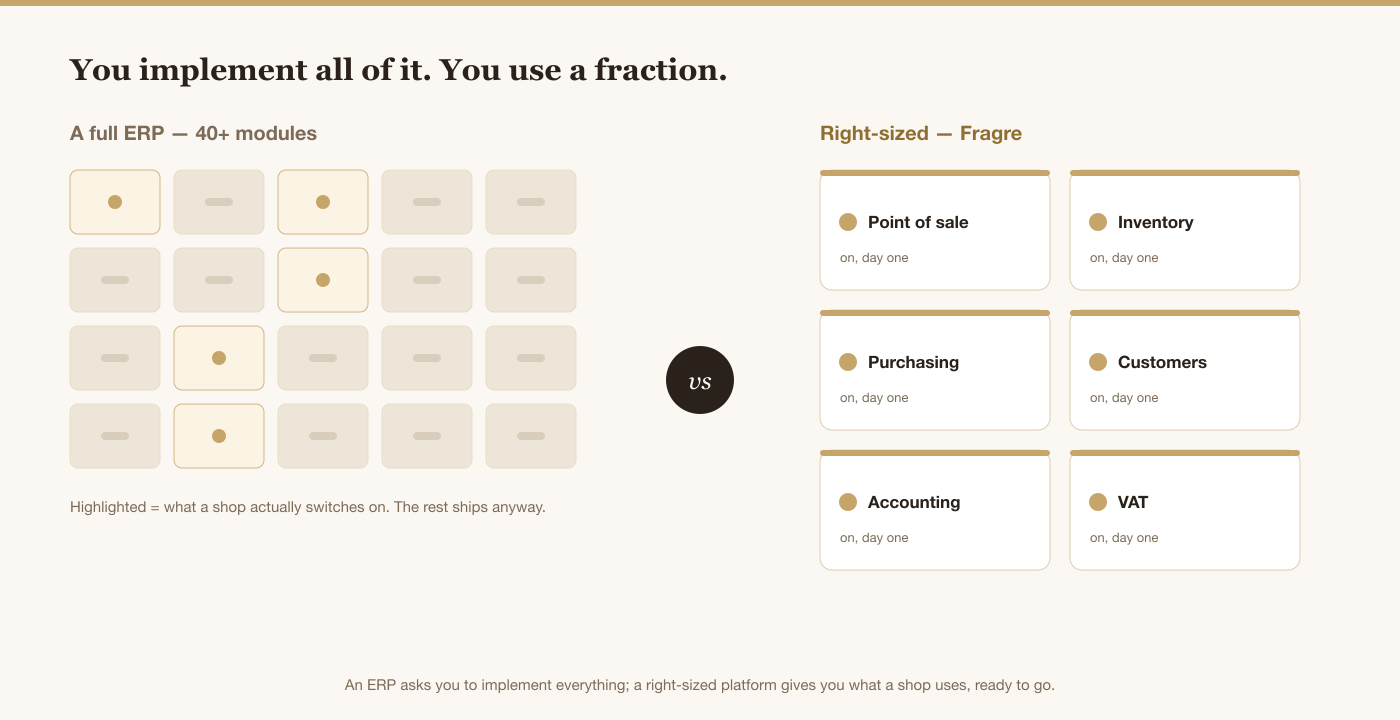
The core of it is a choice about scope. An ERP hands you everything and asks you to implement, configure and maintain it; a right-sized platform hands you what a shop actually uses, already working. Here's that difference in one picture:
1. Ready to trade today, not after an implementation
There's no project, no partner and no months-long rollout. You sign up, add your products, and start selling — with your point of sale, stock, customers and books all live from the first sale. The gap between "we chose it" and "we're running on it" is measured in hours, not quarters.
Consider what "getting started" usually means with a full ERP: scoping which of the dozens of apps you'll actually use, mapping your processes onto them, migrating data, testing, training staff, and often paying a partner to shepherd it all — before a single real sale runs through the system. With a right-sized platform, that entire phase simply doesn't exist. You add your products and open the till. For a business that needs to be trading now, not next quarter, that difference is the whole point.
2. Right-sized for a shop, not a factory
Kyndle One gives you the tools a retail or service business actually uses every day — point of sale, inventory, purchasing, customers, accounting and VAT — designed to work as one. You're not paying for, configuring around, or being confused by manufacturing, project management or a dozen modules you'll never switch on. Less surface area means less to learn and less to go wrong.
3. One connected system, one source of truth
A single sale updates your stock, your books, your VAT and the customer's history at the same moment, because it's one product — not modules you integrate. That's the same principle behind avoiding the real cost of running on separate tools, delivered without the weight of an ERP.
4. Built for the UAE out of the box
Kyndle One handles 5% VAT and proper tax invoices natively, works in English and Arabic, prices in AED, and is actively preparing for the UAE's mandatory e-invoicing from 2027. It's shaped around how UAE businesses actually trade, rather than localised onto a global core after the fact. If accounting is your worry, our guide to accounting software for a UAE small business shows how the books stay current on their own.
5. Simple enough for an owner — no consultant required
Kyndle One is built to be run by the person who owns the business, not a trained ERP administrator. Clear screens, a new cashier productive in a morning, and no configuration language to learn. The value of an ERP is flexibility; the cost is complexity — for most SMBs, that trade isn't worth it.
6. Predictable pricing, and it grows with you
One subscription covers the platform — no implementation fee, no per-module surprises, no customisation invoice. And when you open your next shop, Kyndle One runs it as part of the same business; our guide to a POS system for multiple branches covers exactly how.
Kyndle One vs Odoo, at a glance
| Odoo | Kyndle One | |
|---|---|---|
| What it is | Full modular ERP | All-in-one retail platform |
| Getting started | Implementation project, often a partner | Sign up and trade the same day |
| Scope | 40+ apps across every function | The tools a shop actually uses |
| Who runs it | Admin / consultant / IT | The business owner |
| UAE fit (VAT, Arabic, AED) | Via localisation & setup | Built in out of the box |
| Pricing | Per-user/app + implementation + hosting | One predictable subscription |
| Best for | Complex / manufacturing / large operations | Small & mid-size UAE retail & service |
ERP power isn't the goal — running your shop is
Kyndle One gives a small or mid-size business everything it needs in one platform, ready on day one — no implementation project.
Request a demo →An honest note: when Odoo is still the right choice
Odoo genuinely wins for some businesses, and it's only fair to say so. Choose Odoo if you need manufacturing or MRP, complex multi-department or multi-company workflows, or deep customisation to model a process no off-the-shelf tool covers. Choose it if you have IT resources or an implementation partner and want maximum flexibility, or if you value the control of an open-source platform you can self-host and extend. For a growing enterprise with real operational complexity, that breadth and openness are a genuine advantage.
But if you're a small or mid-size retail or service business, the honest question isn't "which ERP is most powerful?" It's "what's the least system that runs my business well?" For most shops, an all-in-one built for exactly that beats an ERP you have to tame.
The real cost: subscription vs total cost of ownership
ERP pricing is famously more than the licence. With Odoo, the true cost typically includes per-user and per-app fees, the implementation itself (often the largest line), any customisation you commission, hosting if you self-manage, and ongoing maintenance and upgrade work. Those are real, recurring investments — worth it when you need what an ERP delivers, and a heavy overhead when you don't.
An all-in-one platform folds the whole thing into one predictable subscription with nothing to implement. The honest comparison isn't licence-to-licence — it's Odoo's total cost of ownership against a single monthly figure. For most SMBs that don't need ERP depth, the all-in-one comes out both simpler and cheaper, and it frees the time and money an implementation would have consumed.
Is Kyndle One right for your business?
A quick gut-check. Kyndle One is likely the better fit if most of these are true:
- You want to be up and running now, not after an implementation project.
- You sell to customers over a counter and want a real POS at the centre.
- You don't need manufacturing, MRP or heavy multi-department workflows.
- You're in the UAE and want VAT, Arabic and AED handled out of the box.
- You'd rather run the business yourself than manage an ERP or a partner.
- You want one predictable bill, not licences plus implementation plus upkeep.
If you ticked most of those, you don't need an ERP — you need a system that's already shaped for you.
Switching to Kyndle One
- Export your products — names, SKUs, prices and stock — from your current system.
- Import them into Kyndle One as one shared catalogue.
- Set an accurate opening stock count per location.
- Configure VAT, branches and staff roles — minutes, not a migration.
- Run a normal day and watch sales, stock, books and VAT all move on their own.
The bottom line
Odoo is a remarkable ERP, and if you need that breadth and can invest in implementing it, it's a strong choice. But power you don't use is just complexity you pay for. For a small or mid-size business — especially a UAE retail or service business — that wants point of sale, inventory, accounting and VAT working together, ready on day one and simple enough to run yourself, Kyndle One is the better place to start. Not a smaller ERP — the right-sized system that does what you actually need, and grows with you when you're ready.
Related guides
Frequently asked questions
Is Kyndle One a good Odoo alternative?+
For a small or mid-size retail or service business — especially in the UAE — yes. Odoo is a powerful full ERP, but running it usually means an implementation project, a partner and ongoing maintenance. Kyndle One gives you point of sale, inventory, accounting and VAT in one platform that's ready to use on day one, without that overhead.
What is the best Odoo alternative for a small business in 2026?+
The best alternative isn't a smaller ERP — it's a right-sized platform that does what a shop actually needs without the setup. If you want to start trading quickly with POS, inventory, accounting and VAT working together, an all-in-one built for retail like Kyndle One is usually the better fit than implementing and maintaining an ERP.
Why would I choose Kyndle One over Odoo?+
Kyndle One is ready to trade the same day (no implementation project or partner), right-sized for a shop rather than a factory, built for the UAE out of the box (VAT, Arabic, AED, e-invoicing readiness), simple enough for an owner to run, and priced as one predictable subscription with nothing to implement. You get the tools you use, working together, without ERP complexity.
Is Kyndle One easier to set up than Odoo?+
Considerably. Odoo typically involves choosing and configuring modules, migrating data, customisation and training — often over weeks with a partner. With Kyndle One you sign up, import your products, set VAT and branches, and start selling the same day. The gap between choosing it and running on it is hours, not quarters.
When is Odoo the better choice?+
Choose Odoo if you need manufacturing or MRP, complex multi-department or multi-company workflows, or deep customisation to model a unique process — and you have the IT resources or an implementation partner. For larger or more complex operations that want maximum flexibility and open-source control, Odoo's breadth is a genuine advantage.
Run your business smarter with Kyndle
Point of sale, inventory, accounting and AI insights in one calm place.
Request a demo